Welcome to Geometry!
Geometry literally translates to mean “to measure the earth.” Therefore, at its root, Geometry involves measuring. Throughout this class we will be measuring a variety of lines and objects. We will explore the relationships between points, lines and the coordinate plane. We will also look at polygons, circles, and other three-dimensional figures and discover how they can be used to solve problems in real-life situations. Geometry can be found not only in other areas of mathematics, but also everywhere in daily life. It is my hope that through this course you will come to appreciate and enjoy the field of Geometry as much as I do!
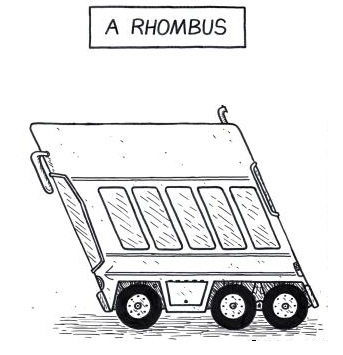
Image found at: Cartoon Stock. <http://www.cartoonstock.com/newscartoons/cartoonists/tzu/lowres/tzun1106l.jpg>.
Useful Websites:
-
A Brief History of Pi - http://www.calculatoredge.com/math/mathhistory/historyans26.htm - If you are having any trouble understanding where the value of p comes from, check out this website. There is a short (less than 1 page) description of where the value 3.14 comes from, as well as some other interesting information about pi. Even if you aren't having any trouble with this concept, there are some other historical facts that you might find interesting.
- Algebra vs. The Cockroaches - http://hotmath.com/hotmath_help/games/kp/kp_hotmath_sound.swf - Need practice finding the equations of lines? Play Algebra vs. The Cockroaches! The object of the game is to find the equation of the line in time to destroy the cockroaches. This game is a great place to practice finding the equations of lines in slope-intercept form (the kind we will be using) and have some fun too. You have to be able to identify both the slope and the y-intercept. The game starts out at a fairly easy level, and then progresses to lines that take a little more computing as you play longer.
-
Area of a Circle - http://www.khanacademy.org/math/geometry/circles-topic/v/area-of-a-circle and http://www.khanacademy.org/math/geometry/basic-geometry/e/area_of_a_circle- Khan Academy has another excellent informational video, this time covering the area of a circle. The first link, featuring the video goes through a word problem and shows each step of finding the area of circles. This is another great video that you can watch any time you need extra help. The second video, is a place where you can practice finding the area of circles. These are a great two websites.
- Circle Tool - http://illuminations.nctm.org/ActivityDetail.aspx?ID=116 - This activity from Illuminations lets you change the radius or diameter of a circle to investigate its circumference. Once you have played around with the circle, you can practice calculating the circumference or area within a time limit. This is a cool activity and a great way to practice your math!
- Flatland Movie Trailer - http://www.youtube.com/watch?v=C8oiwnNlyE4 - This is the trailer for the animated movie Flatland. The movie is based of a novel by Edwin A. Abbott and tells the story of a two-dimensional world as it explores the third dimension. Flatland is a fun movie that helps comprehend the differences between dimensions and how they build off of each other. If you are struggling to understand this relationship or any kind of three-dimensional figures, this is a great movie! We will also watch it closer to the end of the year when we are discussing the fourth dimension as the movie touches on this idea as well.
-
Graphing Calculator Tips - http://mathbits.com/MathBits/TISection/Openpage.htm - This website has step-by-step instructions with pictures for how to solve almost any problem on a graphing calculator. This website is a great resource to help you use your calculator when you might have forgotten exactly where some of the commands are located. The website is set up for TI-83 or TI-84 calculators, but if you are using a different model, many of the commands may be very similar. If you are still having difficulties using your graphing calculator, please ask me and we will figure it out.
- How to Study Mathematics - http://www.math.osu.edu/students/how_to_study.html - The Ohio State University Department of Mathematics put together this list of guidelines to help students succeed in math. Even though this was set up for college students, all of their suggestions apply for the high school classroom as well. Math is a difficult subject for most students to study for, as there aren't as many definitions or study questions as there are for other subjects. These tips give a great list of suggestions to help you study. As the article says, it would be a bit overwhelming to try each and every one of the suggestions, so pick the ones that seem the best fit for you and see if your results improve!
-
Meta Calculator - http://www.meta-calculator.com/online/ - This is a free online version of several different graphing calculators. You can choose from graphing calculators, scientific calculators, matrix calculators, or statistic calculators. Use this when you don't have a graphing calculator or when you aren't sure how to use it.
- Pi is (still) Wrong - http://www.khanacademy.org/math/geometry/circles-topic/v/pi-is--still--wrong - There isn't a lot of mathematical ideas behind this video, but it is a funny take on pi and radians and explains why the concept is somewhat confusing. And finally, pi is looked at as piE rather than a number!
- Prove It! - http://feromax.com/cgi-bin/ProveIt.pl?task=getproofslist - Prove It is a website we will use throughout this year for extra practice with two-column proofs. If you are struggling with proofs at all this is a great website for some extra help. Choose a topic we are covering or have covered class, and just choose each statement and reason in order. When you are finished, the website will grade the proof for you! We will use this website during class, but it is a great study tool for outside of class as well!
-
Pythagorean Explorer - http://www.shodor.org/interactivate/activities/PythagoreanExplorer/ - Pythagorean Explorer is an interactive program you can use to practice using the Pythagorean Theorem. The program generates a random right triangle, with one side length missing. Your job is to find the missing side! This is a great site you can use to practice applying the Pythagorean Theorem with a variety of different triangles. There are 3 different levels of difficulty available, so work at the pace that is best for you. A lot of these triangles will look similar to ones you might see on a quiz or test, so this is good practice!
-
Pythagorean Theorem - http://mathematica.ludibunda.ch/pythagoras.html - On this website you will find a variety of information about the Pythagorean Theorem. The site offers a proof, as well as an interactive proof. In the interactive section, you can maniulate a square to see how the side lengths truly do relate so that the Pythagorean Theorem is true. There is also a section on this website dedicated to the history of the Pythagorean Theorem which is very interesting, and might be useful on a test or quiz at some point! We will look over this website in class, but you will be responsible for looking at it more in depth on your own.
- Radius, Diameter, and Circumference Video - http://www.khanacademy.org/math/geometry/circles-topic/v/circles--radius--diameter-and-circumference and http://www.khanacademy.org/math/geometry/basic-geometry/e/radius_diameter_and_circumference - The first link is an educational video discussing the relationship between a circles radius, circumference, and diameter. The video is a bit dry, but the concepts are important and the video is very informatioal. The narrator is very thorough and does an excellent job explaining the topics. The second link is to a website where you can practice these same skills. First, watch the video to refresh your memory, and then do the practice problems.
-
Symmetry Game - http://www.innovationslearning.co.uk/subjects/maths/activities/year3/symmetry/shape_game.asp - The symmetry game tests how well you can identify lines of symmetry in given shapes. This interactive game randomly generates a shape, and your only job is to correctly answer how many lines of symmetry are in the shape. Although the game is very simple, some of the shapes can be tricky, so make sure to answer carefully! This is a great game you can use to practice during our unit on symmetry.
-
Symmetry in Nature - http://jwilson.coe.uga.edu/EMT668/EMAT6680.2002.Fall/Nazarewicz/7210_final_2/7210_Project/index.html - If you are looking for some great examples of how math can be found in real life, check out this website. There are links to radial symmetry, strip pattern symmetry (which is similar to translations), wallpaper symmetry, and bilateral. The radial symmetry and bilateral symmetry are the ones most similar to what we have talked about in class. You can use this site not just to see examples of symmetry in nature, but also to test yourself. Pick any picture and try to identify the lines of symmetry in that scene. This is a great method to help yourself recognize lines of symmetry. Keep these images in mind when we are looking for our own examples later this year!
-
Ten Commandments of Math - http://www.english-for-students.com/10-Commandments-of-Math.html - This site takes the original Ten Commandments, and puts a math spin on them! Although the site is meant to be somewhat humorous interpretation, but the 10 rules are a good set of a guidelines for any math class. Live by these 10 rules, and you will be set for success in this class and any others!
-
What Pi Sounds Like - http://www1.teachertube.com/viewVideo.php?title=What_Pi_Sounds_Like&video_id=224868 - This is a really neat video made my a musician who put the value of pi into various notes and chords and made a song (watch the video for an exact description). If you do not have a good understanding of music, the beginning may be a bit hard to follow, but for those of you who are musically inclined this will be really interesting. The first 31 digits of pi are played in a round by several different instruments and the end result is a very enjoyable song. If you are a music person, this is a must see video, and even if you are not this is a video you will enjoy. Just more proof that math is everywhere all around us!
-
Wolfram Alpha - http://www.wolframalpha.com/ - Wolfram Alpha is a great site that will calculate any problem for you, or give you almost any kind of information. It is a site that can be used as a mathematical search engine. You can use Wolfram Alpha to answer questions about any topic, but unlike other search engines, Wolfram Alpha will answer questions directly related to math. This is a great resource if you are ever working alone and can't remember a definition, or how to compute something. Wolfram Alpha won't just give you the answer, but it will also explain the process. Please remember that just copying an answer from Wolfram Alpha is cheating, so if you use this website on your homework, make sure that you still show all of you work, and remember to cite the website on your paper!

|
Syllabus.docx Size : 36.002 Kb Type : docx |
